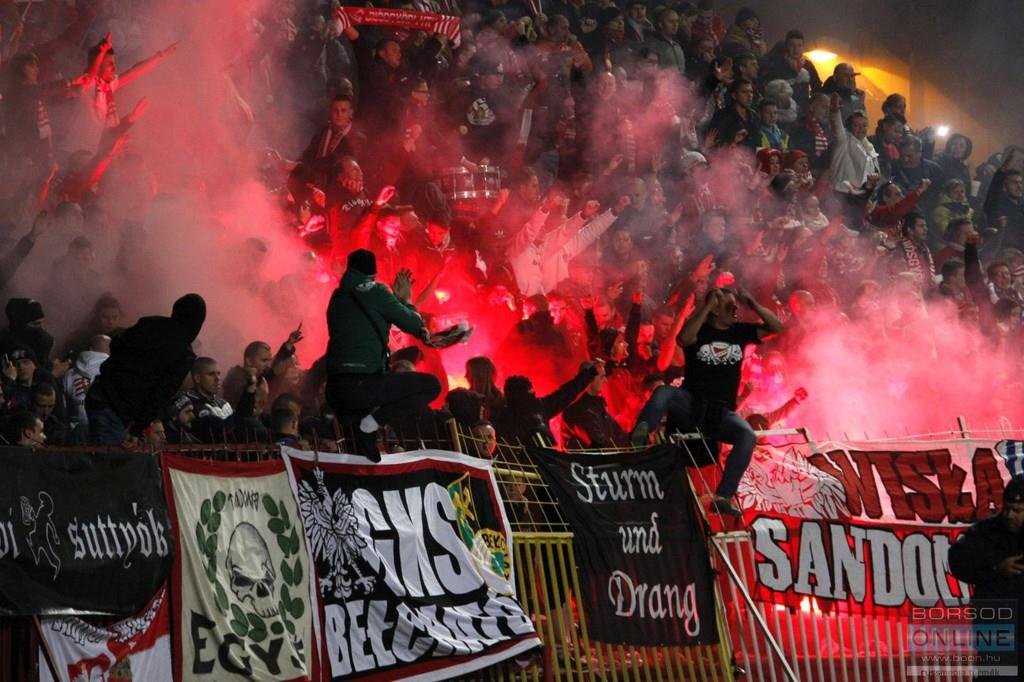
Football is more than a game. It often reflects deeper social frustrations and tensions. The anger we see in stadiums, whether toward referees, players, or rival fans, can mirror wider feelings of injustice and distrust in institutions. In that sense, football becomes a window into how societies express and release collective emotion.
The anger directed at referees, players, or rival fans can mask deeper dissatisfaction with systems or governments that feel unjust.
Football Crowds and Social Tension
At El Massira Stadium in the Moroccan city of Safi, the April 19 competition for a place in the final of the Confederation Cup was overshadowed by scenes of disorder.
USM Alger advanced to the final, edging out their Moroccan opponent, but the match “was delayed by more than an hour due to crowd disturbances, setting the tone for a chaotic evening before the football itself took centre stage,” CAF Online reported.
The celebration of football victories has increasingly been associated with chaos and violence, occasionally resulting in fatalities.
Stadiums offer one of the few spaces where life’s pressures can be released openly.
When Algeria qualified for the 2010 World Cup, it was seen as a return to the world after years of civil war. Around that time, Algeria saw frequent public disturbances, many linked to football-related violence. Riots such as those in Oran in 2008, after a local team's relegation, led to burning buildings and looting, with similar incidents occurring across the country.
This unrest reflected broader political and social tensions, especially during the period of regional uprisings in 2011, which pushed the government to take measures such as lowering prices of basic goods.
When a team loses, it is not simply a sporting defeat; it can feel like a personal or collective loss. What may seem like overreaction is, in reality, a form of identity defense.
Rivalries intensify these dynamics. The presence of opposing fans reinforces divisions, turning the stadium into a space where deeper social tensions are performed.
Football thrives on emotion—loyalty, excitement, tension—but under certain conditions, team passion can quickly turn into disorder. A controversial decision, a provocative chant, or the anonymity of a large crowd can dissolve individual restraint, creating a collective intensity that is difficult to contain.
The anger directed at referees, players, or rival fans can mask deeper dissatisfaction with systems or governments that feel unjust.
By focusing only on visible behavior, society ignores the deeper forces at play—economic hardship, identity struggles, and social marginalization. Blaming fans is easier than confronting these structural issues.
Stadiums, in this sense, act as mirrors of society. The tensions that erupt within them are not created there; they originate outside. Inequality, exclusion, and struggles over belonging do not disappear at the stadium gates—they intensify. The crowd is not separate from the world beyond the pitch; it is a reflection of it.
To understand football crowds, then, is to understand something deeper about society itself. The anger, the passion, and even the moments of disorder are not random. They are expressions of lived realities. Rather than dismissing them, we should ask what they reveal. In doing so, we move beyond blaming fans and begin to see the stadium for what it truly is: not just a place of sport, but a space where society speaks.