Pakistan has managed to balance the interests of major global players—releasing doves of peace toward Iran instead of bullets, in one of the world’s most volatile regions.
Pakistan has managed to balance the interests of major global players—releasing doves of peace toward Iran instead of bullets, in one of the world’s most volatile regions.
Pakistan released doves of peace toward Iran before
Pakistan has succeeded before in cooling tensions with neighboring Iran. Now, Islamabad has emerged as a pivotal mediator in the effort to de-escalate the current war in Iran.
At the dawn of 2024, direct border skirmishes erupted between Iran and Pakistan. Despite the gravity of the situation, the speed and discipline with which both countries contained that crisis sent a powerful message to the world: the region is capable of managing its own conflicts without external intervention.
Pakistan, in particular, succeeded in cooling tensions at the time with the Iranian Revolutionary Guard Corps along the eastern frontier.
Now, Pakistan is in talks with countries along Iran’s maritime and land borders as the Strait of Hormuz remains restricted.
Amid escalating tensions with the United States and Israel, Islamabad has mobilized intensive intelligence and diplomatic channels to prevent a catastrophic miscalculation that could plunge the region into further chaos.
In this month’s newsletter, Atlas Broadcasting explains how Pakistan is navigating the current negotiations.
Communication amid toppled leadership
Following the assassination of Supreme Leader Ali Khamenei, the region stood on the brink of open war. At that critical juncture, the Pakistani leadership—through its foreign ministry and intelligence apparatus—engaged in rapid shuttle diplomacy, relaying messages between Tehran and Washington to ensure that any Iranian response would remain “calibrated” and would not trigger a devastating American retaliation reminiscent of Hiroshima.
Pakistan was acutely aware that a full-scale U.S. war against Iran would unleash millions of refugees and facilitate the infiltration of armed groups across its borders—an outcome its economy and national security could not withstand.
Navigating armed groups in border triangle
Closed-door discussions in Israel reportedly advanced a scenario centered on exploiting armed groups operating within the volatile Iran–Afghanistan–Pakistan border triangle, particularly in the vast region of Balochistan. This territory, divided among the three countries, includes Pakistan’s Balochistan province, Iran’s Sistan and Baluchestan provinces, and parts of southwestern Afghanistan.
Armed factions such as the Balochistan Liberation Front and the Balochistan Liberation Army, alongside smaller militant groups, were seen as potential destabilization forces. These factions, long dormant yet highly volatile, would require only a capable sponsor willing to provide weapons, funding, intelligence, and logistical support to reemerge.
Their successful infiltration across porous borders would almost certainly destabilize Iran internally, deepen fractures within its leadership, and potentially fragment the Islamic Revolutionary Guard Corps, pushing military commanders toward defection—echoing the uprising against Bashar al-Assad’s regime in Syria.
Such a scenario likely would carry catastrophic consequences: widespread civilian casualties from bombings and insurgent attacks, profound disruptions in regional security balances, and the rise of armed groups unacceptable to Gulf states. Pakistan has moved decisively to prevent such instability.
Quiet regional coordination
Acting in close coordination with Saudi Arabia and a regional alliance comprising Turkey, Iraq, and Afghanistan—countries geographically tied to the Iranian frontier—Islamabad has launched a quiet but intensive diplomatic effort. This behind-the-scenes coordination explains the Pakistani Prime Minister Shehbaz Sharif’s visit to Riyadh on March 12, where he met Crown Prince Mohammed bin Salman, as well as high-level communications between Saudi and Iraqi officials the following week.
A bridge to Washington
Pakistan also engaged the United States, urging Washington to pressure Tel Aviv to abandon any such destabilizing plans, which would ultimately undermine American economic and strategic interests in the Middle East.
As a result, Pakistan has emerged as a pivotal actor in efforts to de-escalate the 2026 U.S.–Iran confrontation. Leveraging its unique relationships with both Tehran and Washington, as well as its shared border with Iran and its longstanding strategic alliance with the United States, Islamabad has assumed the role of a “diplomatic bridge.”
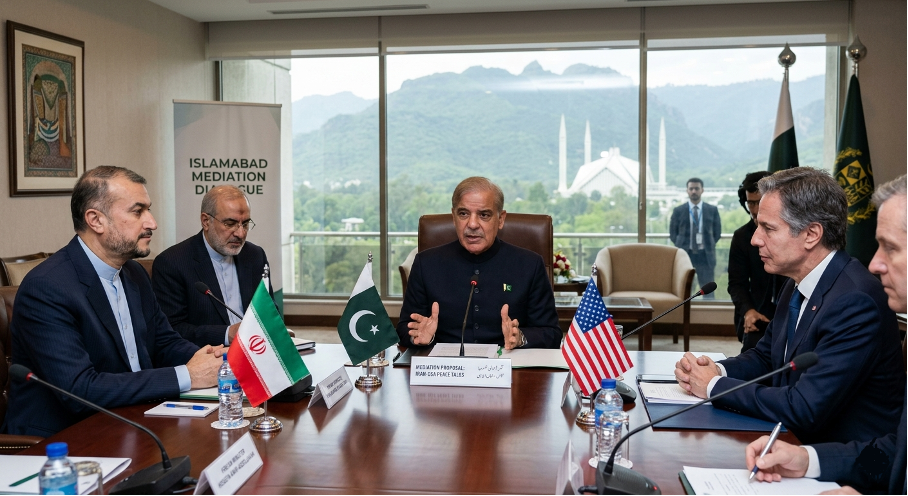
Pakistan facilitated the exchange of direct messages between the Iranian and American leaderships and contributed to shaping a ceasefire proposal. Prime Minister Shehbaz Sharif announced a two-week ceasefire agreement between the United States and Iran, achieved through Pakistani diplomatic efforts.
Islamabad also hosted Iranian and American delegations for talks aimed at reaching a comprehensive settlement to the conflict. Furthermore, Pakistan’s efforts helped secure safe maritime passage through the Strait of Hormuz, easing fears of a global energy crisis. These diplomatic initiatives received backing from China, with Pakistan’s foreign minister visiting Beijing to brief Chinese officials on the progress of negotiations.
In doing so, Pakistan has managed to balance the interests of major global players while projecting itself as a stabilizing force—releasing doves of peace toward Iran instead of bullets, in one of the world’s most volatile regions.