More than 25 years after the Kosovo War ended, its legacy continues to shape how young Serbs and Kosovo Albanians understand identity, belonging and one another. Understanding how these inherited memories sustain political tensions — and whether they can instead become a starting point for dialogue — is essential to imagining a more sustainable peace in the Western Balkans.
When Teodora, 22, asks her parents to tell her stories from when they were young, one scene keeps returning: her mother crossing the streets of Belgrade to meet her father as bombs fall from the sky. The year was 1999. For Teodora, the NATO bombing is less a history lesson than a family story — one that has shaped how she understands Kosovo despite being born after the war.
When Teodora, 22, asks her parents to tell her stories from when they were young, one scene keeps returning: her mother crossing the streets of Belgrade to meet her father as bombs fall from the sky. The year was 1999.
“It’s very empowering how they stayed together,” she says.
For her, the NATO bombing is less a history lesson than a family story. But the legacy of the war also shapes how she imagines Kosovo today, through stories she grew up hearing: that Serbs should be careful in Kosovo and would be better off not going there.
Teodora grew up with stories, fears and memories inherited from those who experienced the 1998-99 conflict. Her reality raises a question at the heart of the tensions between Serbia and Kosovo: what happens when a generation inherits the memories of a war it never experienced and is then asked to imagine a future beyond it?
The Kosovo War was the culmination of years of escalating tensions. More than 25 years after the fighting ended, the conflict has not disappeared so much as changed form.
In 1998, Serbia was one of Yugoslavia's six constituent socialist republics, while Kosovo was an autonomous province within Serbia. Under Josip Broz Tito, who ruled Yugoslavia as prime minister or president from the end of World War II until his death in 1980, the state promoted a broader Yugoslav identity through the principle of "Brotherhood and Unity," seeking to hold its diverse national and ethnic communities together. During this period, Kosovo with 90 percent of the population ethnically Albanian gained significant political, cultural and linguistic autonomy.
The political landscape began to shift in 1989 when Slobodan Milošević, then president of Serbia, drastically curtailed Kosovo's autonomy as Serbian nationalism became increasingly central to his political strategy.
Throughout the 1990s, repression of Kosovo Albanians intensified alongside resistance to Serbian rule, eventually escalating into armed conflict between Serbian/Yugoslav forces and the Kosovo Liberation Army (KLA). In March 1999, after diplomatic efforts to end the conflict failed, NATO launched a 78-day bombing campaign against Yugoslavia to protect ethnic Albanians. That June, Yugoslav forces withdrew from Kosovo, and the UN Security Council established an international civilian and military presence. For nine years, Kosovo remained under UN interim administration before declaring independence in 2008, a move Serbia continues not to recognize.
“I’m Albanian; by the way, don’t call me Kosovar,” says Hana, 22. “I grew up in Kosovo, surrounded by my family, friends, and a culture and community where Albanian traditions and history are very important.
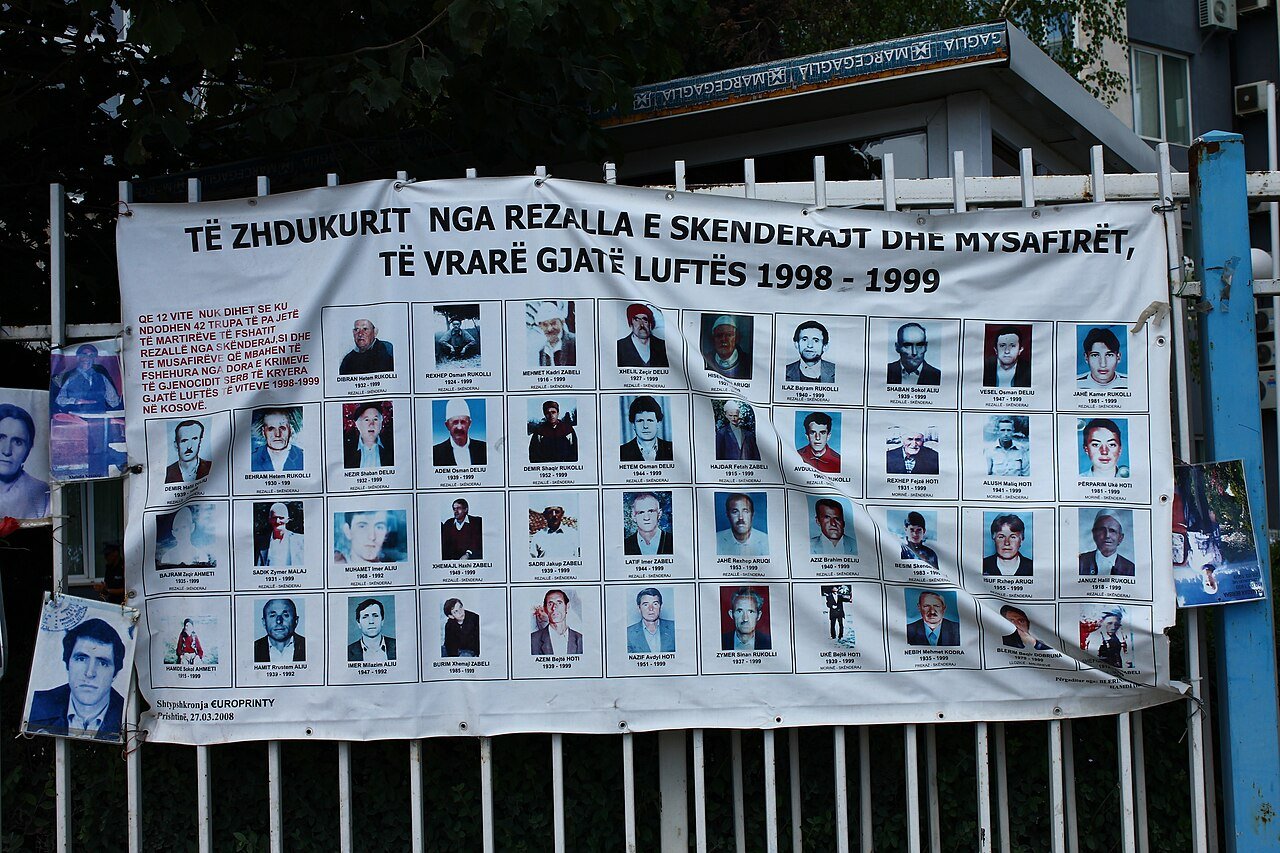
Hana, just like Teodora, first heard the stories of the conflict through family members before learning more about it in school. And both women, each on a side of the border, illustrate what Columbia University Prof. Marianne Hirsch, who was born in Romania to Holocaust survivors, calls postmemory: the transmission of traumatic experiences through family stories, images, silences, and cultural narratives. Their memories of the war are therefore mediated by the people who experienced it: by stories of displacement, bombing, loss and survival, told within their families and communities.
For many Kosovo Albanians, the conflict can be remembered as a road from oppression to independence. In dominant Serbian narratives, the same period is often remembered through the loss of control over Kosovo, NATO's bombing campaign, and the displacement and suffering of Serbs.
Memory can be contested, not because each side believes that different events occurred, but because the stories young people listen to tell different perspectives of the event.
Memory can also be mobilised.
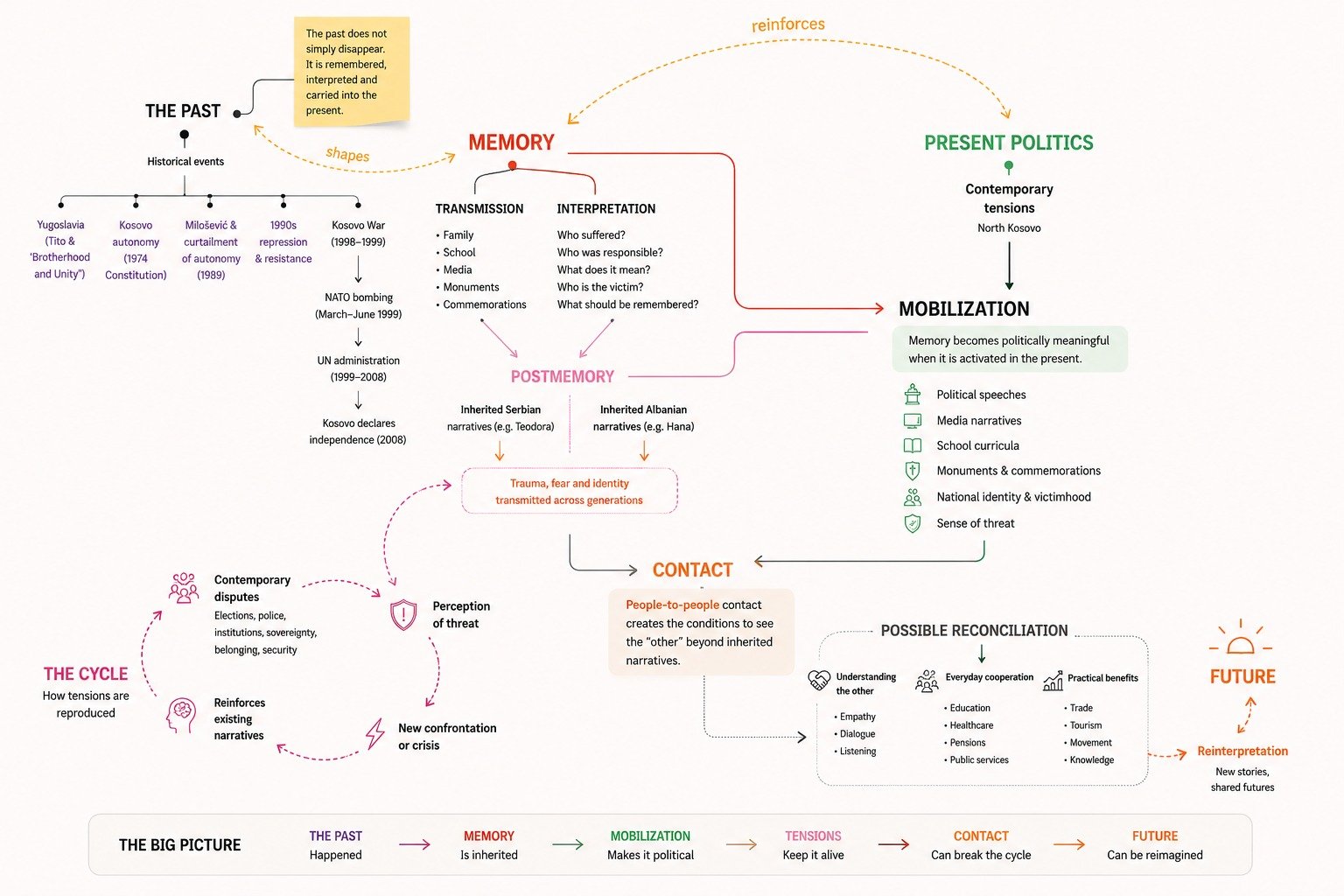
According to Eric Gordy, who has written extensively on the Balkans, memories themselves do not necessarily have a political consequence, but they can become politically meaningful if someone activates them in the present. Memory is always produced in the present: we remember the past from where we stand.
So, what does remembering the Kosovo War accomplish today?
For Gordy, a professor at the University College London’s School of Slavonic and East European Studies, the answer is partly political.
Memories of past violence can be useful in the present, he pointed out, explaining how political actors can invoke episodes of the past to reinforce a sense of threat, victimhood or national solidarity.
In Serbia, he argues, the NATO bombing has become particularly powerful in shaping how many people understand the conflicts of the 1990s.
Teodora explains that in Belgrade “there are some buildings that are ruined completely [because of the bombs] and that are still left like that, ruined in the middle of the city, to remind us about what happened.”
Memory, especially collective memory, does not exist only in family stories, but in school lessons, city monuments, the media. Memory is transmitted and reproduced through institutions, from holidays and celebrations to political speeches.
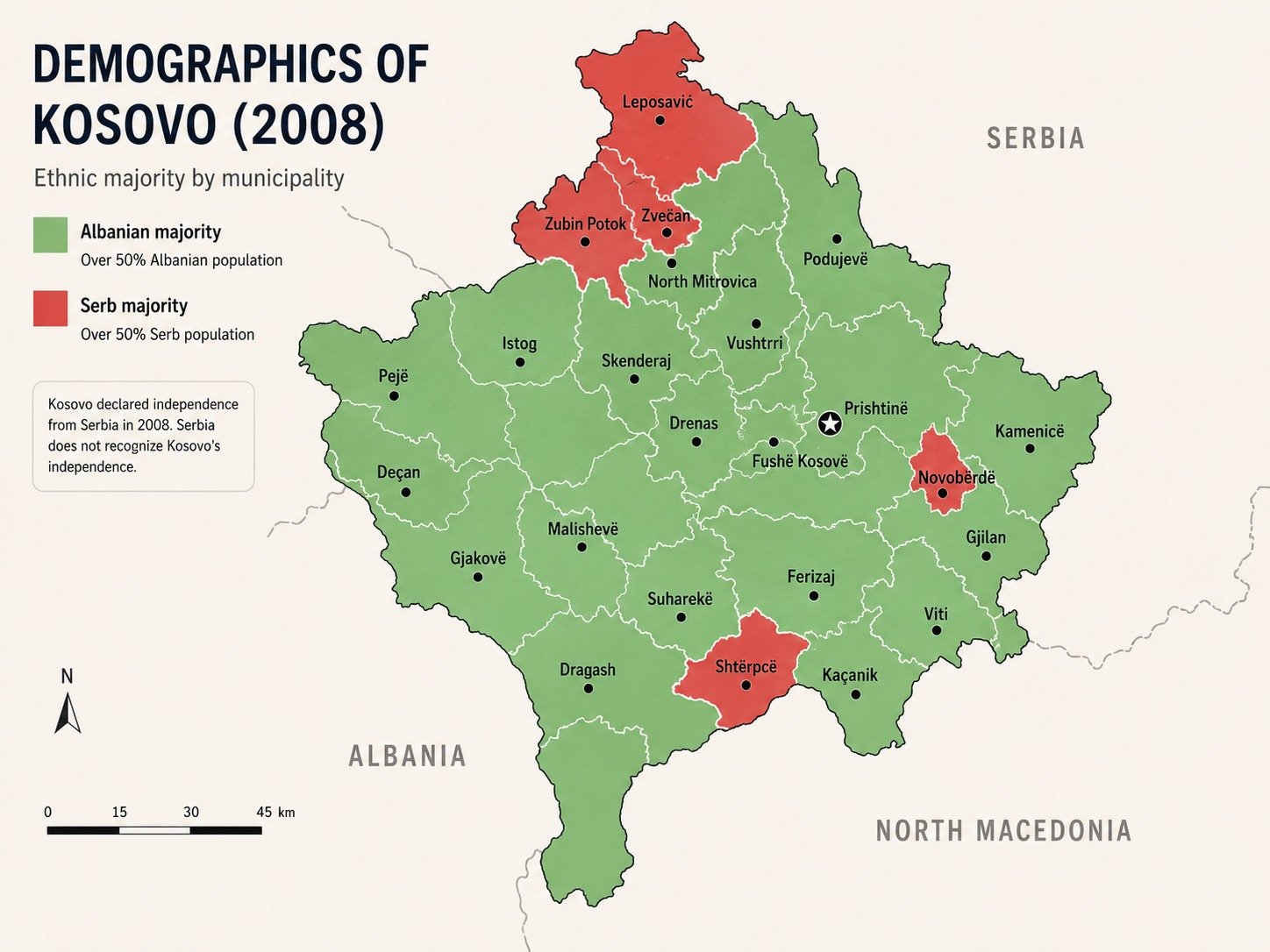
The north of Kosovo demonstrates how the conflict's unresolved past can become entangled with present-day politics. Disputes over elections, police and Serbian-supported institutions are not merely administrative disagreements: They are interpreted through competing understandings of sovereignty, victimhood and belonging.
“The thing that makes it difficult is that tension is a resource,” states Gordy.
There is a mutual reinforcement of perceptions of threat, and current tensions, such as the ones around the northern Kosovo municipalities of North Mitrovica, Zvečan, Zubin Potok and Leposavić show how a dispute that goes back to the 1990s has changed 30 years later. When every new confrontation can be interpreted as evidence that the other side remains a threat, the past becomes a framework for understanding the present.
But if memory can be mobilised to sustain division, it can also be challenged.
The question, then, is not whether Serbia and Kosovo can agree on a single version of the past, but whether younger generations can build relationships that are not entirely defined by it. Both Hana and Teodora hope for a better future, one with less grudges about the past. Neither of them sees this future in sight.
When then, will reconciliation truly happen?
“A lot of people in the region don’t like this word reconciliation,” answers Gordy.
For those who were tortured, held in camps, and persecuted, the idea of reconciliation with their aggressors can be hard to swallow. There are people open to dialogue and many grassroots initiatives on communication between the peoples, but that is not the norm.
“Reconciliation” for the professor can signify contact: everyday people who cross the border and discover, against their expectations, that “the other one” can be friendly, that there are beautiful landscapes to be seen, that everyday peace can look like movement — of trade, of tourism, of knowledge even. The region cannot live in isolation, and top-down actions on the political level will not be enough on the social one.
The past can be acquired. It can be mobilised. But it can also be encountered, questioned, and reinterpreted. Breaking the cycle of mutual threat and tension may take generations, and it may only be broken if citizens from both sides question the narratives they have been given to be open enough to reach dialogue.
The generations that inherit the Kosovo War do not have to inherit its boundaries.