By not taking a historical view of how Iran operates in putting spheres of influence and preservation of its political order ahead of economic interests, the United States miscalculated on eventual outcomes of a war it started.
The United States has long been operating under the idea that if it puts a vice grip on Iran’s economy, its leaders will eventually become more reasonable. The reality is that Tehran puts economic interests behind hefz-e nezam, the preservation of the political order. That order includes maintaining control of proxy forces through Lebanon, Iraq, Syria, Yemen, and elsewhere. The Islamic Republic is more likely to change course when it can show its own people that any compromise with the United States is a tactical decision, not a public defeat.
For decades, the United States has returned to the same wager on Iran: make the country poorer, and its leaders will eventually become more reasonable. Restrict the oil trade. Close the financial channels. Make imports scarcer, the currency weaker, daily life harder.
At some point, the theory goes, ideology will yield to arithmetic. Iran has spent nearly half a century testing that theory.
Economic punishment can hurt Iran deeply. However, Tehran does not see GDP growth, export earnings, or foreign investment as the ultimate measure of national success. The numbers matter, but they rank below a more basic objective: hefz-e nezam, the preservation of the political order.
As Iranian journalist Saman Safaza told me recently: "This is not a government that stays awake at night staring at GDP tables. It stays awake staring at maps of influence where its narrative travels, where its allies sit, and where it can raise the cost of being its enemy."
That map runs through Lebanon, Iraq, Syria, Yemen, and beyond. It includes armed partners, religious institutions, political factions, and the capacity to make a confrontation with Iran expensive for anyone who tries.
U.S. President Donald Trump's Iran strategy misread this hierarchy of priorities. It assumed Tehran would eventually face a choice between economic survival and the tools that protect its political order. But the regime treats those tools as an insurance policy, not an optional expense — one that lets it survive economic crisis, internal dissent, and foreign coercion.
The Real Scoreboard: Ideology, Loyalty, and Control
To understand why economic pressure fails, one must know how the Islamic Republic measures success. Four decades of Iran's official rhetoric and behavior tell us the regime evaluates its progress through ideological and revolutionary indices.
The people are not the source of legitimacy; they are the subjects of guardianship in the same sense a guardian is appointed for a minor deemed incapable of managing his own affairs. So, the regime's real indicators are about control, not consent: the growing reach of the Guardian Council to disqualify candidates and voters, the transformation of elections into rituals of allegiance rather than genuine contests, and the steady expansion of unelected bodies at the expense of parliament and the presidency.
On the economy, the regime's project is often mistaken for redistribution or anti-corruption. In practice it has built the opposite: a concentrated oligarchy bound to the system by patronage. Religious foundations, or bonyads, control an estimated 20 to 40 percent of Iran's GDP with no parliamentary oversight.
Internally, the regime measures success by the concentration of economic power inside semi-state institutions controlled by the Revolutionary Guards. Success is not about spreading wealth, but about building a class whose economic survival depends entirely on the regime's political survival through loyalty-based patronage and the institutionalisation of corruption within loyal networks.
When Iran Actually Compromises
None of this means Iran is immune to pressure. Over four decades, Tehran has changed course but only when external pressure meets three conditions at once: 1. it imposes a tangible, measurable cost; 2. it directly threatens the core interests of regime survival, elite economics, or the regime's ideological and military networks; and3. it leaves an acceptable off-ramp, allowing the regime to frame the shift as a voluntary tactical decision rather than public surrender.
The end of the Iran-Iraq War shows this pattern clearly. Tehran repeatedly rejected ceasefire proposals through the mid-1980s despite catastrophic losses. By 1988, the calculus changed: Iran lost the strategic edge at al-Faw peninsula, the U.S. Navy struck Iranian oil platforms directly, and Iraqi forces advanced again into Iranian territory. The threat became existential and the cost became concrete, and UN Resolution 598 offered Ayatollah Khomeini a way to accept peace framed as his own bitter but chosen decision, famously "drinking from a poisoned chalice," rather than surrender to Washington or Baghdad.
A more recent, micro-level example demonstrates this same logic. For decades, the regime banned women from attending men's football matches. Massive domestic pressure failed to move the state. However, when FIFA threatened to ban Iran from international competitions, a move that would strip the regime of vital domestic prestige and international normalisation (conditions 1 and 2), Tehran quietly yielded. Its government framed it internally as compliance with international sporting regulations (condition 3), explicitly avoiding the appearance of a surrender to domestic opposition.
The Real Center of Gravity
Strategists studying the 2026 war eventually return to the question Clausewitz asked of any conflict: where is the center of gravity, the single point that, if broken, brings the whole structure down? For the Islamic Republic, it was never the missile arsenal or the nuclear program. It was whether ordinary Iranians would separate from the regime in a moment of crisis and take to the streets.
Tehran understood this before Washington did and paid an extraordinary price to prevent that separation. Roughly 50 senior military, security and political officials, including the supreme leader, Ayatollah Khamenei'were killed in targeted strikes during the 2026 war, at a direct cost to Iran estimated at well over a hundred billion dollars.
Yet within hours of Khamenei's death, a successor was named, the Guard pledged loyalty, and the state did not fracture, because the one outcome the regime feared most — mass estrangement between the population and the state — never materialised. That was the product of a deliberate strategy: present the regime as the reasonable party willing to negotiate, cast itself as the victim of foreign aggression, and repeatedly offer talks both sides understood were unlikely to succeed.
All as a means of denying the West the one prize it needed most.
Washington made this easier than it should have been.
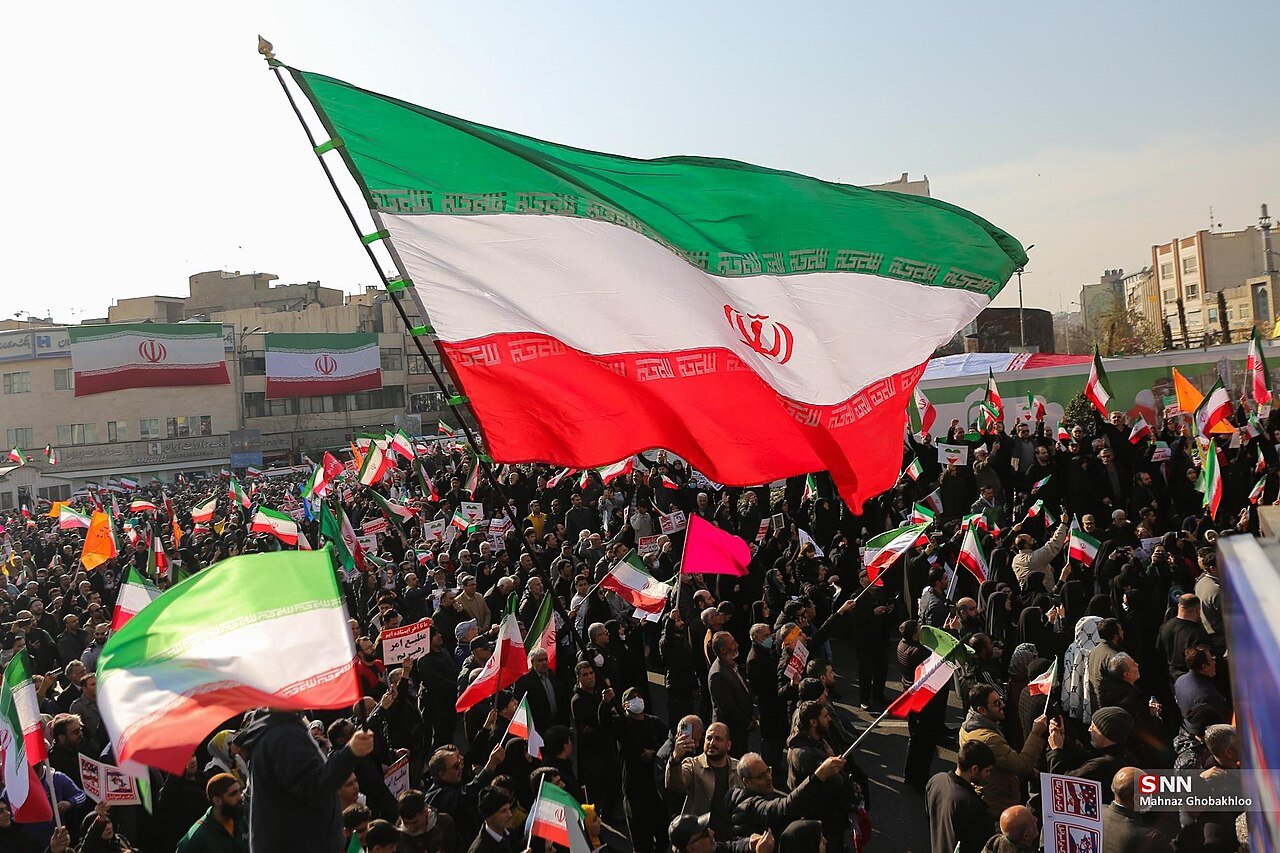
For years, American and Israeli officials floated scenarios of an ethnic uprising and a "new Middle East" redrawn along sectarian lines, treating Iran like Libya, Iraq, or Syria — a fragile state held together by force, rather than a nation with a continuous four-thousand-year sense of territorial identity. The result was predictable: Even Iranians who despise the regime rallied not around the Islamic Republic but around the idea of Iran itself. Washington's rhetoric never made the distinction.
Threats of breakup handed Tehran exactly the nationalist narrative it needed, making resistance to foreign pressure look like patriotism rather than loyalty to the regime.
A different approach was available and remains available now. Had U.S. policy signaled recognition of Iran as a serious regional power, it would have severed the link between Iranian nationalism and regime survival far more effectively than any bombing campaign.
The Better Question
The question for policymakers was never how much economic pain Iran could absorb before capitulating. It was what combination of pressure, diplomacy, and recognition can change Tehran's calculations without convincing the regime or the Iranian public that the nation's survival, not just the regime's, is what's at stake. Iran will not trade its ideological survival for prosperity. It will trade its tactics, but only when the cost is concrete, the threat is real, and there is a dignified way out.
The Islamic Republic is more likely to change course when it can present that shift at home as a tactical decision, not a public defeat. The Mecca Joint Defence Agreement is not proof that Iran has already changed, and its effectiveness will depend on whether its founders turn their political commitment into credible military coordination. But it is a live test of a different, more effective model: regional deterrence that challenges the strategic metrics Tehran values most, paired with the diplomatic off-ramps that make tactical compromise possible.