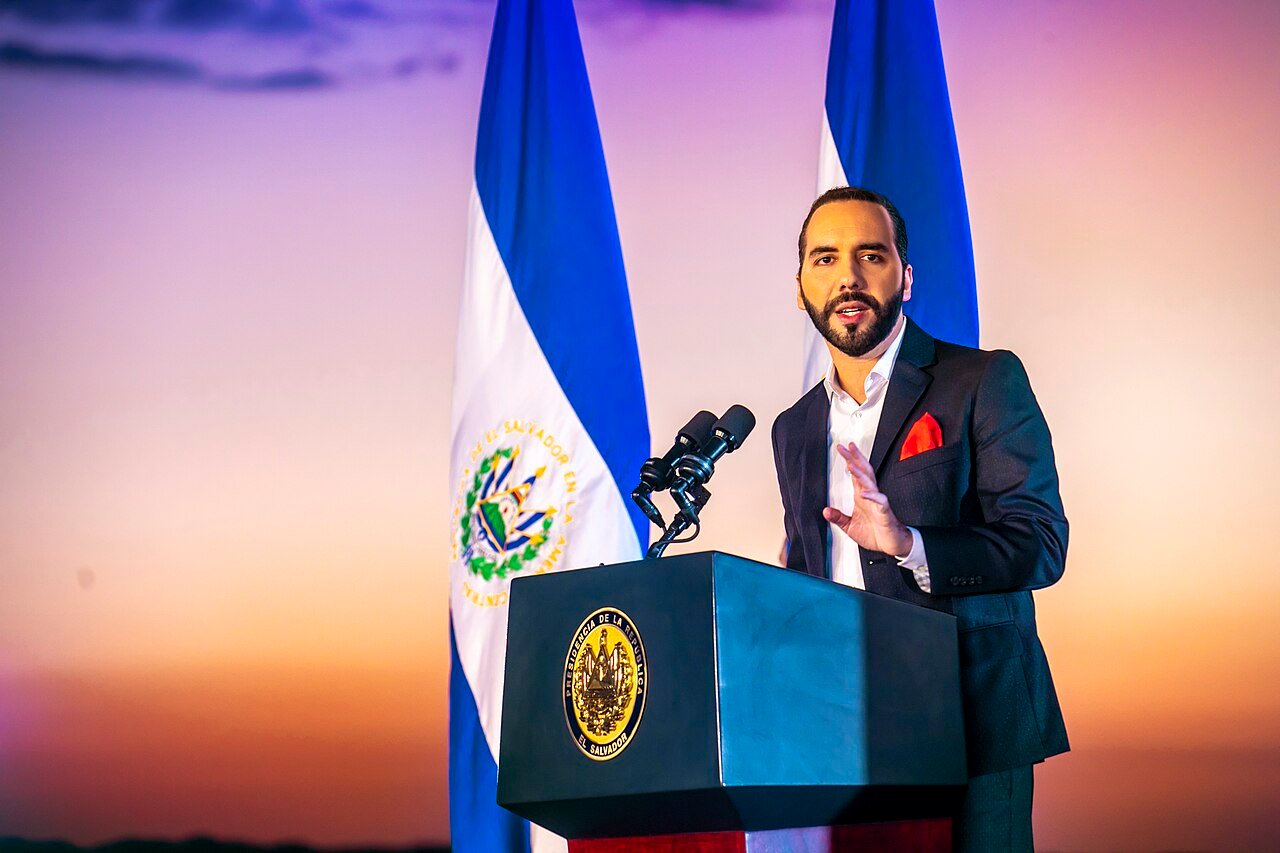
Since 2019, El Salvador has undergone one of the most dramatic political transformations in Latin America. While the government maintains extremely high approval ratings thanks to falling homicide rates and the weakening of gangs, lawyers, analysts, and electoral observers warn of democratic backsliding, concentration of power, and the erosion of institutional checks and balances.
When Nayib Bukele took office in 2019, he inherited a country exhausted by fear. For years, fear in El Salvador took many forms: gangs, invisible borders, extortion, killings, forced displacement, and entire communities controlled by criminal structures. Then came political exhaustion. Corruption scandals discredited political parties, and decades of public frustration had left many Salvadorans convinced the country’s institutions no longer represented them.
Bukele himself had been expelled in 2017 from the Farabundo Martí National Liberation Front (FMLN), the historic left-wing party under which he built much of his political career. He later ran for president under the banner of the Grand Alliance for National Unity (GANA), a party founded by politicians expelled from the traditional right-wing ARENA party.
The combination produced an unusual political narrative: a candidate expelled by the left, backed by a party born from a fracture within the right, presenting himself as an outsider to El Salvador’s traditional political system.
The new president quickly built a discourse around the idea of “re-founding” El Salvador; “a new country,” according to official rhetoric, one that had effectively been “born” in 2019.
“That narrative is extremely powerful, both politically and legally, because it represents a break from the past,” said lawyer Roxana Cardona.
According to Cardona, Bukele’s discourse portrays pre-2019 El Salvador as a state awash in corruption, traditional parties, and backroom deals.
Bukele became the first president in decades capable of breaking the bipartisan political system that had dominated Salvadoran politics since the Peace Accords. His anti-establishment rhetoric, aggressive use of social media, and constant attacks against “the same old politicians” resonated deeply with a population exhausted by traditional politics.
But while the new administration consolidated massive public support, warnings also began emerging about the country’s institutional direction.
One of the first major moments of tension came on February 9, 2020.
That day, Bukele entered the Legislative Assembly accompanied by armed soldiers to pressure lawmakers into approving funding for his Territorial Control Plan, the government’s flagship anti-gang security strategy.
The images spread around the world.
The president sat in the chair of the head of Congress while soldiers occupied the legislative chamber and supporters gathered outside.
National and international organizations condemned the event as a threat to democratic balance and an act of military pressure against the legislative branch.
Yet many Salvadorans supported the move.
For them, Congress still represented corruption, political obstruction, and partisan interests, while Bukele projected efficiency, confrontation, and results.
The real turning point, however, arrived in 2021.
In February of that year, Bukele’s party, Nuevas Ideas, won a legislative supermajority.
With control of the Legislative Assembly, the government gained unprecedented power to approve reforms, reshape institutions, and consolidate control over virtually every branch of the state.
On May 1, 2021, the new legislature removed the justices of the Constitutional Chamber of the Supreme Court and the country’s attorney general without due process.
For Malcolm Cartagena, an electoral expert and former official of the Supreme Electoral Tribunal now living in exile, that moment represented the country’s greatest institutional rupture since Bukele came to power.
“When the justices were removed, the natural balance of our system was broken,” Cartagena said.
According to him, the executive, legislative, and judicial branches effectively came under the control of a single political force.
From that point on, a series of reforms deepened the concentration of power.
The government pushed through electoral, administrative, and criminal law reforms that significantly altered the country’s institutional structure. The Legislative Assembly approved reductions in the number of municipalities and lawmakers, changes in electoral districts, criminal law reforms, expanded pretrial detention powers, and procedural restrictions that reshaped El Salvador’s judicial and political systems.
This was followed by the state of exception approved in March 2022 after a spike in gang-related killings.
Although the Salvadoran Constitution establishes that emergency measures can only last 30 days and be extended once for an equal period, the state of exception has remained in force for years through consecutive extensions approved by the ruling-party-controlled legislature.
Over time, the extraordinary gradually became permanent.
For Cardona, these measures are part of an increasingly centralized governing model.
“In the long term, what will be consolidated is a hyper-centralized model with very little possibility of reversal,” she said.
According to the lawyer, local governments have already begun losing real administrative and decision-making power.
As local politics weakens and decision-making becomes concentrated within the executive branch, specialists warn that the distance between communities’ real needs and state priorities also grows.
At the same time, the government’s security strategy dramatically transformed public perceptions of safety.
The state of exception allowed authorities to regain control over territories historically dominated by gangs and sharply reduce homicide rates.
“We can now walk freely, but we don’t know for how long or at what cost,” Cardona said.
But while much of the population celebrated the reduction in violence, human rights organizations and legal experts warned about the democratic and legal consequences of maintaining a permanent emergency regime.
“After years of suspended constitutional guarantees, with neither judges nor lawmakers questioning it, what becomes normalized is a permanent violation of rights,” Cardona said.
During the implementation of the state of exception, the government also enabled anonymous reporting mechanisms, allowing citizens to report alleged gang members or collaborators with impunity.
Human rights organizations warn that these mechanisms, combined with mass arrests and detentions based on weakly verified accusations, contributed to the imprisonment of thousands of people without proven gang ties.
Several organizations estimate that a significant percentage of detainees are innocent individuals prosecuted under the emergency regime.
Mass trials, restrictions on access to case files, expanded pretrial detention, and judicial reforms that critics consider a weakening of due process also became increasingly common.
“If there is no independent legislature or judiciary, then nobody is going to stop decrees, laws, or decisions coming from the executive branch,” Cardona warned.
Even so, Bukele’s public support remains remarkably high.
Recovered security continues to serve as one of the government’s strongest sources of legitimacy.
According to Cardona, El Salvador is now experiencing a clash between two competing visions of democracy.
“They present themselves as a democracy of results versus a democracy of procedures,” she explained.
“In other words, if there is security and public works, then it does not matter whether procedures are ignored.”
That logic, specialists argue, has allowed large sectors of the population to normalize measures that would have been considered unthinkable only a few years ago.