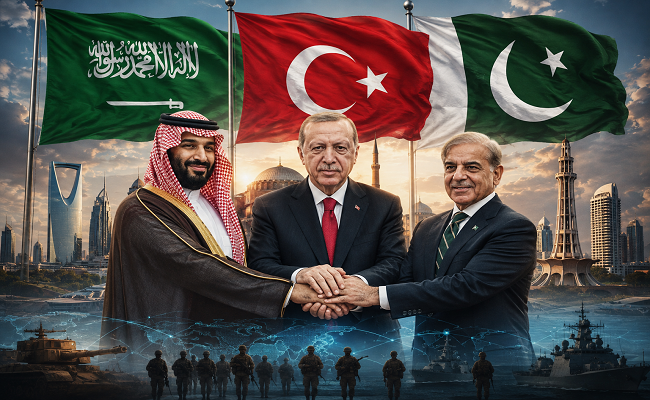
At a time when the peoples of the world are suffering from rising prices of basic commodities, particularly fuel, due to wars and the closure of the Strait of Hormuz, a new alliance has emerged in the region of gas and oil. Its significance extends beyond the borders of its three members. The emergence of a Saudi-Turkish-Pakistani defence framework could reshape the regional balance of power and affect the geopolitical calculations of many Middle Eastern countries and other international actors.
On Aug. 7, Saudi Arabia, Turkey, and Pakistan signed a joint defence agreement in Mecca, carrying a political and geopolitical message that goes far beyond the publicly announced military details. The deal stipulates that any armed attack against any of the three countries shall be considered an attack against all of them. However, the problem begins when we move from the language of statements to the test of power.
Less than 48 hours after the agreement was signed, Yemen’s Houthis announced that they had launched a drone attack targeting a facility belonging to Saudi Aramco in Jazan. A fire broke out and was extinguished, with no reports of casualties. Yet the strategic message was unmistakable: a non-state armed group had managed to test the credibility of a new defence agreement before its ink had even dried. More importantly, Turkey and Pakistan’s response to the attack was as cold as the atmosphere of the South Pole.
The Houthis’ first test was a small strike with a major political impact. Targeting an energy facility with a drone does not constitute a full-scale war, and the significance of the attack lies less in the material damage than in its timing. The Houthis did not need to destroy a strategic facility or inflict heavy casualties. It was enough for them to tell the world that the new agreement does not prevent them from striking Saudi Arabia, nor does it necessarily trigger Turkish or Pakistani military intervention.
This places Riyadh in a difficult situation. If it responds alone, the agreement will appear weaker than the image built around it. But if Saudi Arabia requests military intervention from Turkey or Pakistan, the agreement will immediately move from political deterrence into actual war. This is the real test.
Why Are Turkey, Pakistan, and Saudi Arabia Alone Not Enough to Make the Alliance Succeed?
Turkey possesses a highly developed military-industrial base, extensive operational experience, and advanced capabilities in drones, missiles, and electronic warfare, in addition to its membership in NATO. Pakistan possesses a large army, missile capabilities, and nuclear deterrence. Saudi Arabia possesses financial resources, energy assets, geographic positioning, and the ability to purchase and accelerate the development of air-defence systems. Yet combining all these elements does not automatically produce a unified army. There is a vast difference between possessing military power and having a mechanism that allows that power to be used collectively.
Here, we must address the United Arab Emirates, which is absent from the alliance but a factor that cannot be ignored. Abu Dhabi’s not being part of the trilateral agreement does not mean its withdrawal from the regional security equation. On the contrary, it may be a mistake to analyse emerging balances of power without taking the UAE’s cards into account.
The United Arab Emirates enjoys significant geographic, political, and military influence in the Gulf, the Red Sea, and the Horn of Africa. It also possesses extensive experience in Yemen, having led the military coalition backing government forces against the Houthis and spearheading humanitarian aid efforts. The UAE also has significant relations with various local forces in Mali, Libya, Sudan, and Syria. Most importantly, Abu Dhabi is not on bad terms with Riyadh, Ankara, or Islamabad. This means that its absence from the trilateral military agreement does not mean its absence from the broader network of regional interactions. Therefore, describing a “Turkish-Saudi-Pakistani axis” as a complete substitute for the UAE or the United States in regional affairs would be an excessive simplification — one that could turn the alliance into nothing more than a commodity displayed in the diplomatic marketplace.
Why the Alliance Will Not Move Toward War Against Iran?
Although the agreement came amid a broad regional confrontation with Iran, there are compelling reasons why transforming the deal into an offensive alliance against Tehran remains unlikely.
First, Turkey does not want an open regional war with Iran, given the billions of dollars in trade between Ankara and Tehran. Turkey’s economic, geographic, and security interests make it necessary to manage its relationship with Iran, even amid sharp disagreements between the two sides. Turkish Foreign Minister Hakan Fidan has specifically stressed that the agreement is not directed against Iran.
Second, in recent years Saudi Arabia has moved away from a policy of direct confrontation and sought to build a more harmonious relationship with Iran. Even during the current crisis, Riyadh has continued its military and diplomatic efforts in parallel, emphasising that Saudi Arabia’s hand remains extended to Iran and that it wishes to turn the page on the old ideological conflict between the two sides — the Wahhabis versus the Shiites.
Third, Pakistan shares a long border with Iran and is, in many respects, the country that has benefited the most economically and politically from the Israeli-American war against Iran. Pakistan has moved to and from Iran with the tacit approval of all parties, enabling it to achieve economic and political gains. Entering an open war with Iran would amount to political and strategic suicide for Pakistan, particularly because India would be waiting for such a conflict to erupt and then act in its own interests.
The more realistic objective of the alliance is not war against Iran but containing it within the framework of the alliance, deterring attacks against its members, and improving their collective deterrence and defence capabilities.
Why the Alliance Will Not Move Toward War Against Israel?
The same applies to Israel, although for different reasons. The political rhetoric of the three alliance countries may be highly critical of Israeli policies, particularly regarding Palestine, and the three states have issued joint diplomatic statements criticising Israeli actions in Jerusalem and the West Bank. But moving from a political position to direct war is an entirely different matter.
First, Saudi Arabia has economic and investment calculations linked to its Vision 2030 roadmap, which is aimed at reducing its reliance on oil money and diversifying the economy. Promoting regional stability and a smooth formal transfer of power to Crown Prince Mohammed bin Salman is paramount. A war against Israel would undermine all of this.
Second, Turkey is a NATO member, while its economy, companies, and markets remain closely connected to a broad network of relations with Israeli companies that use the country as a gateway for exporting their products. Turkey has been among the major beneficiaries of the economic dynamics surrounding the Gaza war, as its exports to Israel increased.
Third, Pakistan, facing enormous economic and security challenges, is not in a position to wage a war far removed from its core interests. Its relationship with Israel is largely based on the question of Israel’s proximity to or distance from New Delhi. This is the central issue underlying this complex and sensitive relationship.
If we examine the Saudi-Turkish-Pakistani alliance closely, we find that Saudi Arabia does not want its oil facilities and major development projects to become targets in an open regional war. Turkey seeks to expand its defence and commercial exports. Pakistan needs Saudi investment, energy, and Turkish goods, while at the same time it does not want to become involved in a comprehensive confrontation with Iran or Israel, fearing that its forces would be drained in a conflict that does not directly affect its national security.
Ultimately, a number of analysts pointed out that if the alliance does not take any military action against the Houthis or any country that attacks Saudi Arabia, Pakistan, or Turkey, the alliance will be nothing more than a stylish diplomatic suit, one that the three countries can wear when attending international events.