Video of the soldier doing his duty went viral on social media and serves as a reminder that showing respect when called for is an obligation of everyone.
There are moments when a few seconds reveal more about a society than years of political speeches. What happened at Arlington National Cemetery on U.S.Veterans Day, Nov. 11, was one of those moments. During a visit to the Tomb of the Unknown Soldier, Secretary of Defense Pete Hegseth and members of his delegation were publicly reminded by an Army sentinel to maintain silence and respect. The soldier, Specialist Thomas Iglesias, was simply performing his duty. Yet his intervention, captured on video and widely circulated on social media, quickly became something much larger than a military protocol issue.
It became a reminder that respect is not a privilege granted by rank, wealth, or influence. It is a responsibility shared by everyone.
Perhaps, more importantly, it brought an overlooked figure into the spotlight.
The political fallout from the soldier’s reprimand led Hegseth to award Iglesias the Joint Service Commendation Medal, which recognises meritorious service in joint military activities.
A Monument to Forgotten Humanity
The tomb holds the remains of an unidentified World War I soldier, those of unknowns from World War II and the Korean War, and because of DNA testing advances, ones of an identified Vietnam War casualty, Air Force 1st Lt. Michael Blassie.
The Tomb of the Unknown Soldier is much more than a military memorial. It represents millions of human stories interrupted by war, individuals whose names, dreams, and personal histories were lost but whose sacrifices remain part of the collective memory of nations.
The soldiers who walk the black rubber mat in front of the tomb 30- and 60-minute shifts remind us of an uncomfortable truth: history often remembers generals, presidents, and political leaders, while forgetting the ordinary people whose sacrifices made their achievements possible.
The unknown soldier is a symbol of every human being whose contribution is greater than the recognition he receives.
Behind every signficant national-level achievement, there are countless individuals whose names will never be written in history books. They work, sacrifice, protect, and serve, often without applause, medals, or public acknowledgment.
Their silence does not make their contribution less important. Sometimes, it makes it even more meaningful.
An Ordinary Soldier’s Power
The encounter at Arlington National Cemetery also exposed an important distinction between political authority and moral responsibility.
Pete Hegseth occupies one of the most powerful positions in the American government. Specialist Iglesias, by comparison, is a soldier entrusted with protecting one of the country's most sacred national monuments.
For a brief moment, however, the conventional hierarchy of power became almost irrelevant.
The soldier did not need a political title to understand his responsibility. He did not need public approval to enforce the rules. He simply did what his duty required.
That is the deeper meaning of the incident.
Rules that apply only to ordinary citizens are not expressions of institutional dignity; they are expressions of privilege.
The sentinel's intervention demonstrated something fundamental: the dignity of a place, a responsibility, or a human sacrifice must never depend on the status of those who visit it.
The soldier was not challenging a Cabinet members authority. He was defending the memory of people who could no longer defend themselves.
But the unknown soldier does not belong exclusively to battlefields and military cemeteries.
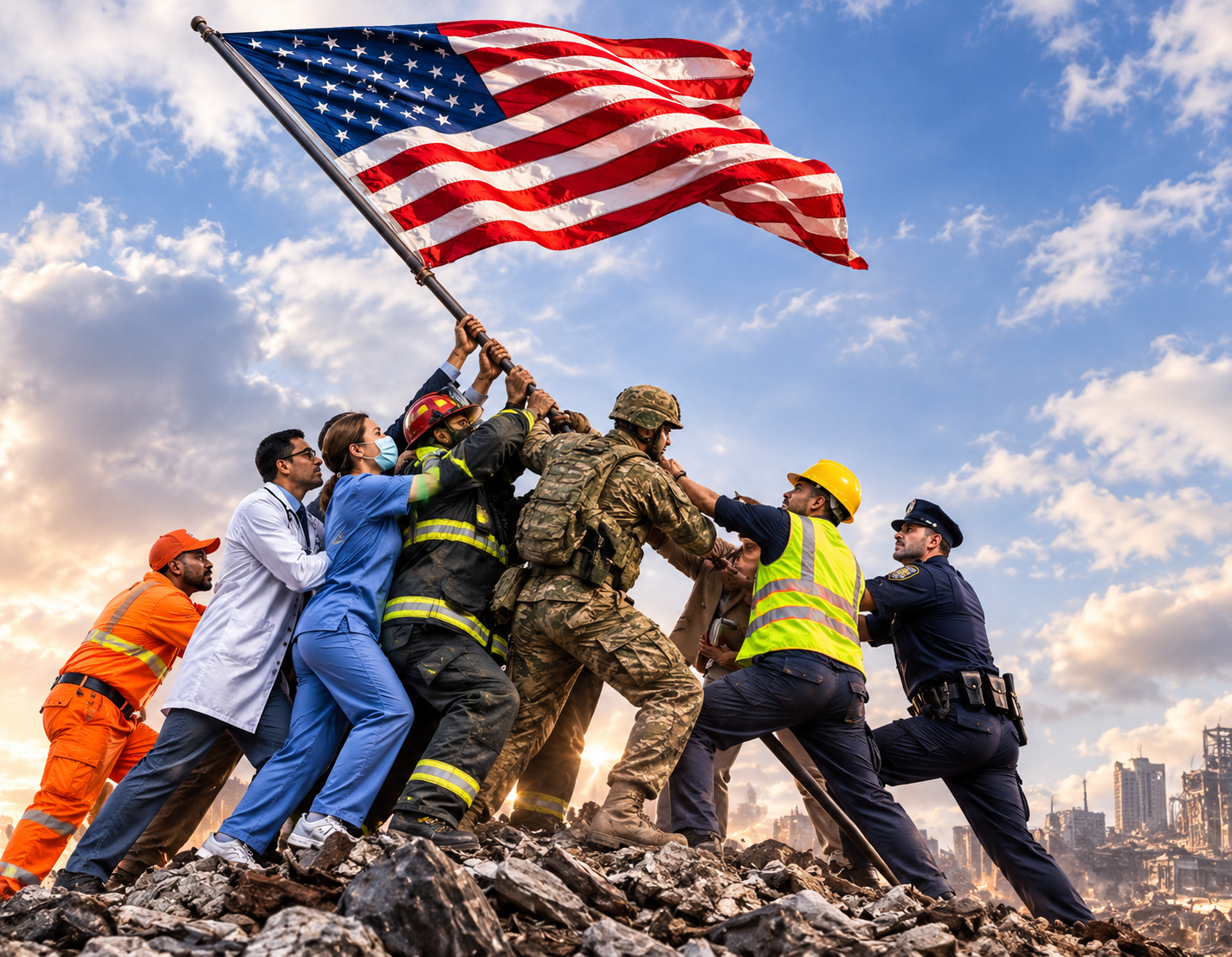
There are unknown soldiers in every hospital, school, factory, farm, and public institution.
Consider the nurse who spends an exhausting night beside a patient, the hospital cleaner who maintains the environment in which lives are saved, or the ambulance driver who rushes toward an emergency while others are moving away from it.
These people rarely receive the recognition given to politicians, celebrities, or business leaders. Yet without them, the machinery of everyday life would gradually collapse.
Civilisation is a collective achievement, constructed every day by millions of people whose identities are often invisible to the wider public.
The greatest injustice is not necessarily that these people receive fewer rewards. It is that society sometimes forgets they exist.
Giving Voice to the Invisible
One unexpected consequence of the digital revolution has been its ability to bring ordinary people into the centre of public attention.
For decades, visibility was largely controlled by traditional media institutions. A person needed an influential position, an important connection or an extraordinary achievement to reach a national audience.
Today, a few seconds of video can change that.
The Arlington incident is a powerful example. A soldier performing a routine responsibility suddenly became internationally recognised because someone recorded a moment that might otherwise have passed unnoticed.
Social media can reveal these outstanding individuals, but genuine recognition must go beyond temporary attention and emotional reactions.
The True Measure of a Civilisation
There is something deeply moving about the relationship between the soldier guarding the Tomb of the Unknown Soldier and the unknown men and women represented by the monument.
The people buried there cannot speak. The sentinel speaks through his discipline.
They cannot defend their own memory. He protects the dignity associated with their sacrifice.
Sometimes, the greatest dignity belongs to the person who quietly performs a responsibility without expecting anything in return.
A soldier standing guard. A nurse holding a patient's hand. A teacher helping a student in a classroom. A farmer cultivating the soil. A cleaner preparing a hospital corridor before the first patient arrives.
Different professions, different uniforms, but one shared human purpose: keeping the world running.
The video from Arlington will eventually disappear from the news cycle. This controversy will be replaced by others, and Specialist Iglesias will continue his duties.
But the message should remain.
The Unknown Soldier is not only the man or woman whose name was lost on a battlefield. She is also the nurse whose dedication goes unnoticed, the worker whose hands keep a city functioning, and the ordinary citizen whose daily sacrifices make extraordinary things possible.
Perhaps the greatest test of a civilisation is not how loudly it celebrates its famous people, but how respectfully it treats those whose names it may never know.
Because the world is not held together by its most powerful people alone.
It is also held together, every single day, by those who serve quietly, faithfully, and without applause.
The Unknown.