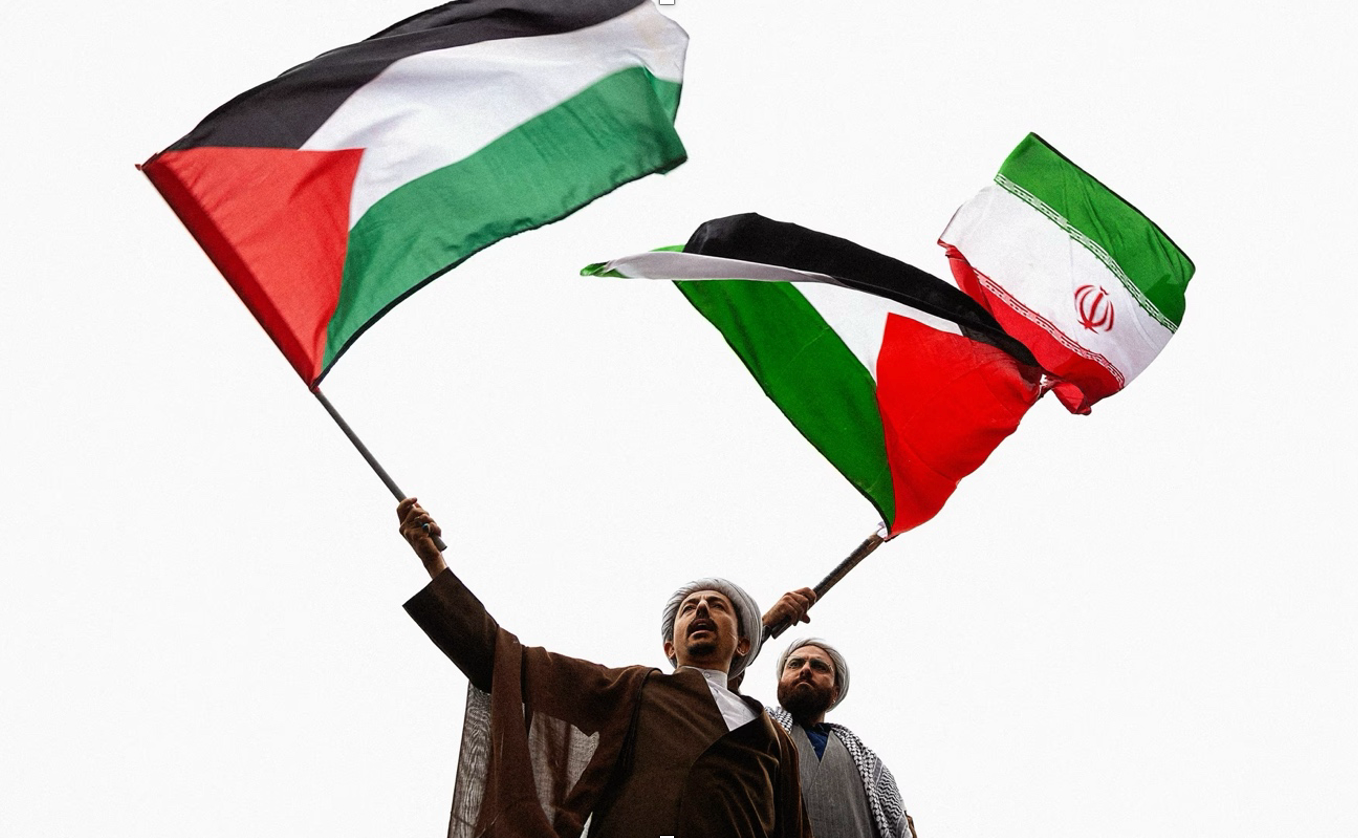
The Palestinian cause remains one of the most powerful political issues in the Middle East. As Iran faces military pressure and regional alliances continue to shift, the conflict is testing whether the Palestinian issue can still shape regional politics, public opinion, and diplomatic relations across the region.
The war targeting Iran has renewed attention on a question that has shaped Middle Eastern politics for decades: what role does the Palestinian issue play in Iran’s regional position?
Khaled Elgindy, senior research fellow in the Middle East program at the Quincy Institute for Responsible Statecraft and former adviser to the Palestinian leadership during negotiations with Israel, said Iran’s support for Palestine has long served both political and ideological purposes.
That relationship has never been without limits. Iran and Hamas, for example, come from different political and religious traditions. Their partnership has often reflected shared interests rather than shared ideology.
The political value of that relationship appears to have grown since the war in Gaza began following the October 7 attack.
Recent research by Arab Barometer suggests that many Arab citizens continue to view Iran’s nuclear ambitions with concern while simultaneously expressing support for Tehran’s position on Palestine. The findings point to a distinction that appears throughout the region; attitudes toward Iran itself often differ from attitudes toward its role in the Palestinian issue.
Michael Robbins, Project Director and Co-Principal Investigator of Arab Barometer and senior research specialist at Princeton University, told Atlas Broadcasting that public perceptions of regional threats remain closely connected to the Palestinian question.
Robbins said Arab Barometer researchers observed significant changes while conducting surveys in Tunisia during the opening weeks of the Gaza war. Support for the United States fell sharply during that period. Attitudes toward Iran followed a different trajectory.
“We didn’t ask about Iran itself,” Robbins told Atlas Broadcasting. “We asked about the foreign policies of Ali Khamenei, the former supreme leader. Day by day, you could trace it, and one day it jumps by about 10 points. We looked back, and that was the day after he asserted that there was a genocide taking place in Gaza.”
For the first time in the organization’s data, Khamenei received as much support among Tunisian respondents than Saudi Crown Prince Mohammed bin Salman and more than UAE President Mohammed bin Zayed in a Sunni-majority country.
Robbins attributed the shift to the central place the Palestinian issue occupies in regional public opinion: “At a level, my enemy’s enemy is my friend. If Israel is the biggest enemy and Iran is fighting Israel, then Iran is your friend because they’re fighting your enemy.”
He added that many respondents increasingly view Iran as “the one country that’s actually fighting, and in this last war really bearing the brunt of standing up in people’s minds for the Palestinian issue.”
That dynamic carries implications for Iran itself.
“I don’t think the regime can afford to abandon completely the Palestinian issue,” Elgindy told Atlas Broadcasting.
The issue has become intertwined with Iran’s regional standing, particularly as rival diplomatic frameworks have struggled to gain traction.
The Abraham Accords, signed in 2020 between Israel and several Arab states, sought to deepen regional cooperation while reducing the centrality of the Palestinian issue in diplomatic negotiations. Analysts remain divided on their long-term impact, though many argue the Gaza war altered the political environment that made the agreements possible.
“The Abraham Accords were designed to circumvent and basically permanently put the Palestinian issue in formaldehyde, if not just make it disappear,” Elgindy told Atlas Broadcasting. “The fact that this also strengthened Iran’s claim to be the champion of the Palestinian issue was a side product. I don’t think it was the goal.”
October 7 accelerated those changes.
“Saudi-Israel normalization was on a path of almost inevitability,” Elgindy said. “That was completely derailed and is now, I think, a virtual impossibility.”
At the same time, support for Palestinian statehood has gained ground internationally. Several European governments have formally recognized Palestine, while public opinion surveys in the United States show narrowing gaps between sympathy for Israelis and Palestinians.
Political gains, however, have not translated into stronger Palestinian institutions.
He argued that meaningful policy shifts are more likely to emerge from changing political incentives than from moral arguments alone.
“At the end of the day, politics is moved by interests, and power responds to other displays of power,” he told Atlas Broadcasting. “What will change is when Republicans and Democrats come to terms with that constituency that is anti-war and realizes these wars are in fact the result of pro-Israel policies and the pro-Israel lobby.”
“The United States’ security, intelligence, everything is so tied in with Israel. It’s really hard to imagine what it would take to break that up. You’re breaking up almost a marriage,” Robbins told Atlas Broadcasting.
Even so, he said public opinion data across the Arab world continues to point toward the same conclusion. Support for normalization with Israel remains low when Palestinian statehood is excluded from the equation and rises significantly when it is included.
“For Arab publics, the idea that the Palestinians deserve to have a state is the cost of doing business with Israel,” Robbins said. “I don’t think Israel is ever going to live peacefully, happily, and safely in the neighborhood it is in if it chooses not to give a Palestinian state.”
Experts:
Khaled Elgindy
Senior research fellow in the Middle East program at the Quincy Institute for Responsible Statecraft and adjunct instructor at Georgetown University's Center for Contemporary Arab Studies. He previously served as senior fellow and director of the Program on Palestine and Palestinian-Israeli Affairs at the Middle East Institute (2020–25) and as a fellow at the Brookings Institution's Center for Middle East Policy (2010–18). From 2004 to 2009, Elgindy served as an adviser to the Palestinian leadership in Ramallah on permanent status negotiations with Israel, including the Annapolis process of 2007–08. He is the author of Blind Spot: America and the Palestinians, from Balfour to Trump (Brookings Institution Press, 2019) and holds an M.A. in Arab Studies from Georgetown University. His writing has appeared in Foreign Affairs, Foreign Policy, The Washington Quarterly, and other publications.
Michael Robbins
Michael Robbins serves as the director and co-principal investigator of Arab Barometer. His work on public opinion in MENA, survey methodology, and political behavior has been published in numerous journals, including Foreign Affairs, Comparative Political Studies, the International Journal of Public Opinion Research, the Journal of Democracy, the Journal of Conflict Resolution, and Statistical Journal of the IAOS. His analysis has been featured by major media outlets around the world including the BBC, CNN, the Economist, Al Jazeera, the New York Times, the Washington Post, the Guardian, the Times of London, Der Spiegel, and Science Magazine. He is also a member of the Council on Foreign Relations.