France, Italy, and Spain face mounting social unrest as economic frustration collides with electoral competition and the wider geopolitical struggle over Europe's future.
Across France, Italy, and Spain, demonstrations over the cost of living, fuel prices, education, housing, and public services are exposing a growing gap between citizens' expectations and governments' capacity to deliver positive results. All three countries have unemployment rates over 6 percent with Spain’s at 10 percent the highest in the European Union. The protests in the three nations share a common political consequence: they are weakening confidence in established parties and creating opportunities for movements promising order, sovereignty, and decisive leadership. The central question is whether this unrest represents a spontaneous expression of accumulated social grievances, a political opening that organised movements are exploiting, or some combination of the two. A further geopolitical interpretation deserves examination about whether the resulting instability could accelerate the rise of Europe's right wing.
France: Economic Frustration, Crisis of Authority
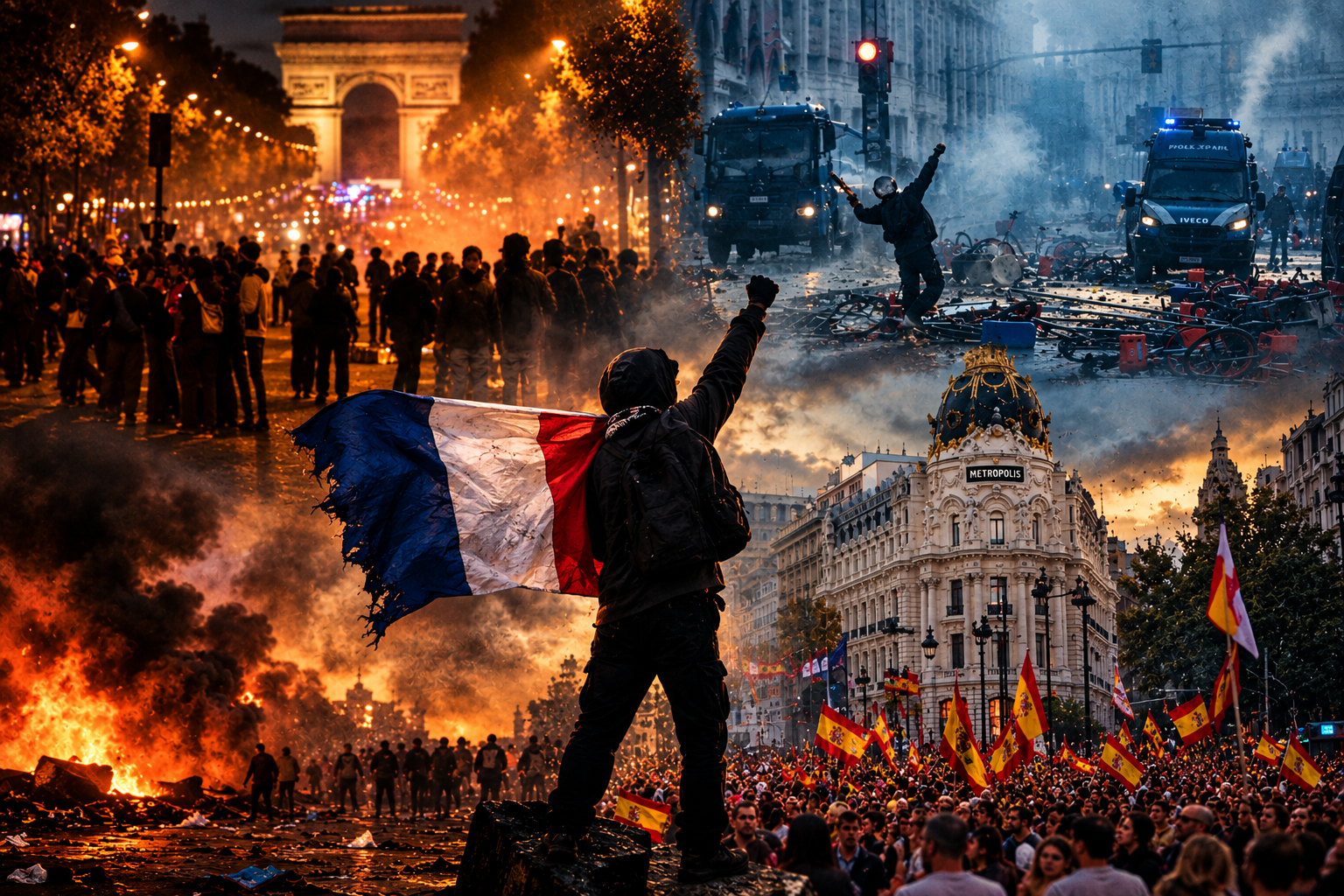
On Oct. 17, the French Interior Ministry estimated that approximately 550,000 people participated in demonstrations nationwide, while organisers put the figure higher. Although many participants marched peacefully, violent confrontations, looting and damage to public buildings overshadowed much of the movement's social message. Police arrested at least 400 people, and media reports said at least 60 police officers sustained injuries.
The unrest revived memories of the 2018-2020 Yellow Vest protests, which exposed deep resentment over purchasing power, regional inequality, and political distance between the elites of Paris and ordinary citizens.
French President Emanuel Macron's government today faces a difficult situation: responding to demands requires financial resources, while a forceful security response risks intensifying public anger. The consequences extend beyond the streets. Public confidence in the political establishment is under pressure, and the crisis offers an opportunity for the National Rally, led by Marine Le Pen's political movement, to present itself as an alternative focused on public order, national sovereignty, and immigration control. Yet the outcome remains uncertain. The protests could strengthen the far right, energise the radical left, or deepen public rejection of the entire political class, depending on how the crisis develops and which forces persuade voters that they can restore stability.
Italy: Political Polarisation
Italy's autumn of 2026 unrest has brought economic anxiety into direct confrontation with the government led by Giorgia Meloni. Demonstrations in Milan, Turin, Bologna, and Rome have brought together students, workers, and other groups dissatisfied with the cost of living, rising fuel prices, the quality of education, and the allocation of public funds. Student mobilisations associated with the slogan “No Meloni Day” have demanded greater investment in schools and universities and criticised government priorities, including military expenditures.
The wider demonstrations reflect a more persistent problem: households facing pressure on purchasing power, workers seeking better wages, and young people concerned about their economic prospects. Some gatherings have escalated into confrontations with police, while the participation of a variety of social and political groups has made it difficult to reduce the movement to a single demand or ideology.
Politically, the protests place Meloni in a complicated position. Her government has built part of its appeal around stability, national identity, and the promise of challenging established political conventions. If unrest continues, opponents can argue that her administration has failed to deliver economic security while supporters can counter that disruption demonstrates the need for stronger public order and more decisive government.
The outcome will depend on whether voters attribute their difficulties primarily to domestic policy, international economic pressures or long-standing structural weaknesses. The protests do not automatically favour either left or right, but they create a contest over who can claim to represent ordinary Italians more credibly.
Spain: Housing Insecurity and Political Representation
Spain's protests have been especially shaped by a housing crisis. In Madrid and other cities, demonstrators have challenged unaffordable rents, housing speculation, and the growing difficulty faced by young people and those with lower incomes in securing stable accommodation. Rising living costs and concerns about public services have added to the pressure, creating a broader sense that economic growth does not necessarily translate into financial security for everyone.
Housing has become a particularly powerful political issue because it affects not only household budgets but also independence, employment mobility, and the ability of younger generations to establish their lives.
Demonstrations and protest camps have helped bring these grievances into the national debate, while educators and other public-sector groups have raised additional concerns about pay and working conditions.
The political consequences are significant for Prime Minister Pedro Sánchez's minority-coalition government, whose ability to respond depends on parliamentary support and the practical limits of housing policy. He has called for a snap general election for Nov. 29 to try to keep his support.
Proposals for emergency intervention have encountered political obstacles, illustrating the difficulty of translating public demands into legislation. The opposition has an opportunity to portray the government as ineffective, while left-wing groups can argue that the crisis reflects inadequate protection against speculation and insufficient public housing.
Right-wing parties may benefit if frustration becomes associated with government failure, but housing grievances can equally strengthen progressive movements demanding stronger social protections. Spain therefore illustrates a central feature of the European autumn: economic dissatisfaction creates electoral opportunities, but it does not predetermine which political camp will capture them.
Spontaneous Anger or Organised Political Opportunity?
The developments in France, Italy, and Spain reveal a common pattern: material grievances generate demonstrations, which expose government weaknesses, and political movements compete to define the meaning of the resulting instability. The fact that protests occur across national borders does not, by itself, establish that they are centrally coordinated. Similar economic pressures can produce similar public reactions without a single directing authority.
Political parties, campaign networks, ideological organisations, and online influence operations can amplify certain images, frame isolated incidents as evidence of national collapse and redirect public anger toward existing institutions.
Who benefits from the escalation of the demonstrations and whether there is evidence of coordination among actors who would otherwise have little reason to cooperate are worth asking.
‘Organised Chaos’
One interpretation describes Europe's current instability as a form of “organised chaos”: a situation in which social discontent may be encouraged, amplified, or strategically exploited to weaken established political forces and accelerate a change in the continent's ideological direction. Under this hypothesis, the political beneficiaries could include right-wing parties promising national control, stronger borders, public order, and a more assertive foreign policy.
Europe's disagreements over energy dependence, defence spending, trade, sanctions, and support for Ukraine have created political divisions. Parties advocating closer economic relations with Moscow, a more confrontational approach to Beijing, or a fundamental revision of European foreign policy can use domestic dissatisfaction to challenge established consensus. Other right-wing movements favour a stronger Atlantic alignment, while some prioritise national autonomy over either Washington's or Brussels' preferences. The European right is therefore not a single geopolitical bloc, and its different factions cannot be assumed to share the same objectives.
Political Weakness of the Left
The ability of left-wing parties and movements to mobilise citizens around wages, housing, education, and public services does not necessarily translate into electoral success. If protests become associated in the public mind with violence, vandalism, or the inability to articulate a practical governing programme, moderate voters may distance themselves from the movements involved.
This creates an opening for right-wing competitors to present themselves as the defenders of order and institutional stability. The mechanism is political rather than automatic: public disorder can increase demand for security, but economic hardship can also deepen opposition to incumbents and strengthen parties advocating redistribution and social protection. Left-wing organisations could lose support if they appear unable to distinguish peaceful mobilisation from violence or to offer credible solutions; they could gain support if voters conclude that governments have ignored legitimate grievances.
A protest movement may dominate headlines and fill public squares while still failing to build the broad coalition needed to win elections.
A Turning Point, Not Yet a Verdict
Europe's autumn of protests has exposed serious weaknesses in the relationship between governments and citizens. France faces a crisis of authority, Italy a confrontation over economic security and government priorities, and Spain sustained pressure over housing and political responsiveness. In all three countries, the unrest creates opportunities for political forces seeking to redefine the meaning of stability, sovereignty, and social justice.
The upcoming electoral contests in Europe will test whether right-wing movements can convert demands for order into durable majorities, whether left-wing parties can retain credibility while defending the right to protest, and whether centrist forces can demonstrate that democratic institutions remain capable of delivering practical solutions.
Europe's political direction will depend not only on who takes to the streets, but also on who persuades voters that they can govern the day after the demonstrations end.