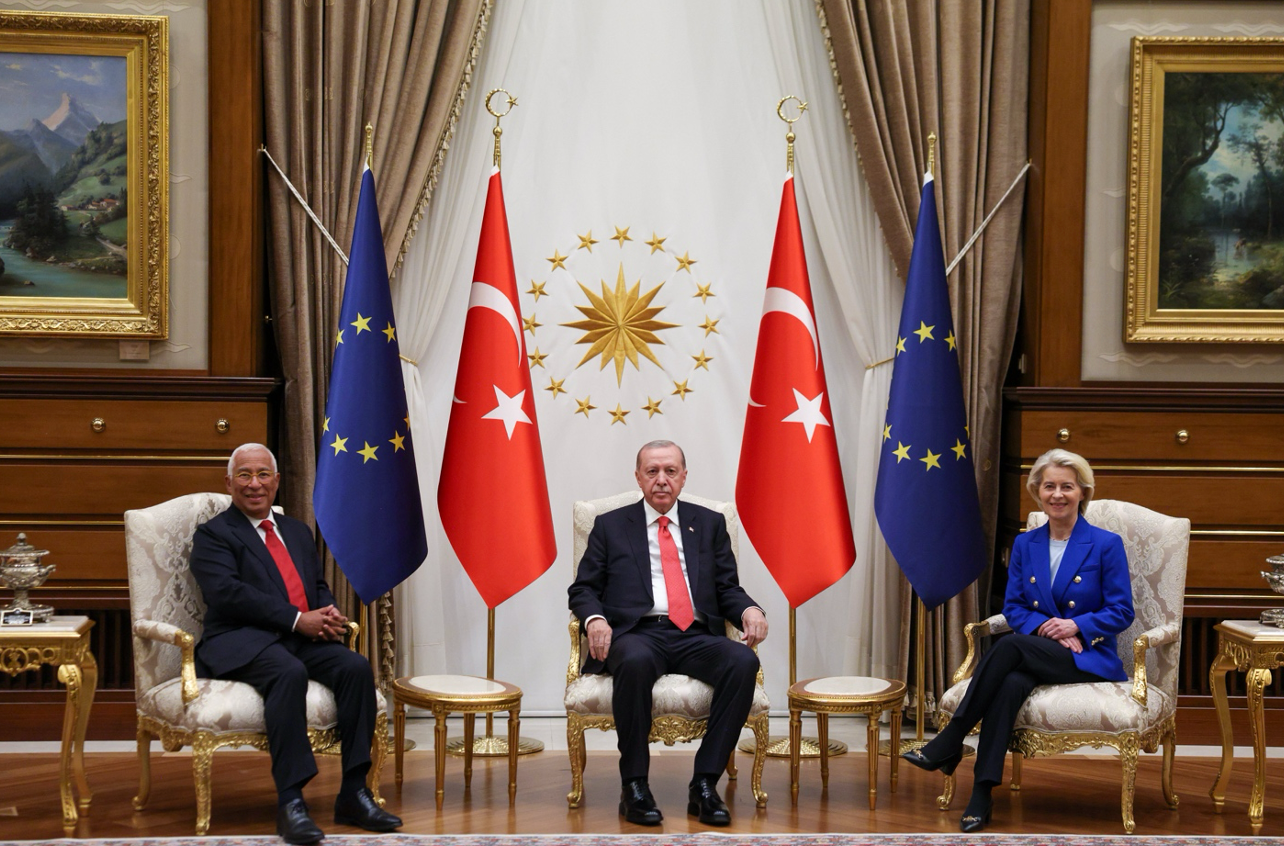
If the United States keeps pulling back from European security, Europe may have little choice but to lean on Turkey — NATO's second-largest army — and accept the leverage and the leader that comes with it.
NATO's summit in Ankara on July 7-8 had threatened to go off the rails even before U.S. President Donald Trump and his counterparts sat down to work, the Associated Press reported. In the end, the countries’ leaders renewed their vow to defend each other, calling their pledge to Article 5 — the alliance's "an attack on one is an attack on all" promise — "ironclad."
It came despite a fresh storm of Trump criticism toward U.S. allies. Soon after he arrived, he lashed out at European partners over Greenland and over their refusal to join his war with Iran, then left declaring "a lot of love" and "a lot of unity" in the room.
Behind the mood swings were concrete numbers. Allies announced roughly $50 billion in new defense procurement and $80 billion more for Ukraine, and Trump agreed to let Ukraine manufacture its own Patriot air defense systems under a U.S. license.
But the most striking prize went to the host. In an uplifting moment for Turkey, Trump announced that the U.S. was prepared to lift sanctions imposed in 2020 over Ankara's purchase of a Russian missile system, opening the way for the possible sale of F-35 fighter jets, despite objections from Israel. "We don't want to sanction friends," he said.
Trump went further: If Turkey President Recep Tayyip Erdoğan had not been hosting the summit, he probably would not have attended at all.
A country in the middle, literally
To understand why the summit landed in Ankara, look at a map. Turkey straddles Europe and Asia, sitting at the junction of the Black Sea, the eastern Mediterranean, the Middle East and the Caucasus. No other NATO ally is in such a position, London’s Telegraph noted. It also controls the Bosphorus and Dardanelles straits, the narrow waterways that govern access between the Mediterranean and the Black Sea.
That geography has long earned Turkey the label of "bridge between East and West," a country that can talk to Russia when others cannot, that armed Ukraine while welcoming Russian tourists, and that brokered the 2022 Black Sea corridor that let Ukraine export its trapped grain in the early months of the war.
The summit put that role on full display. Turkey positioned itself between Russia and Ukraine and between Israel and Iran, acted as a conduit to China, and brought outsiders into the fold, including Syrian President Ahmed al-Sharaa, who met Trump in Ankara. The Telegraph reported that one quip overheard at the summit was that Turkey could even mediate "between the West and the West," between Trump and his exasperated European allies.
Turkey's own communications chief, Burhanettin Duran, embraced the line, saying that in the face of new crises the country is now a bridge "between West and West" thanks to its diplomatic reach.
From bridge to hub and from outlier to pillar
Did the role change?
Analysts argue the bridge framing itself is now outdated. In an era of geopolitical fragmentation, Turkey is becoming something more consequential: a hub through which Europe's security, energy and trade increasingly flow, Mariam Khan, an economist with the OMFIF think tank wrote in a July 7 post, calling the country indispensable to NATO precisely as the U.S. threatens to shrink its role in it.
The numbers back the shift. Turkey's defense exports topped $10 billion last year, most of them to NATO members. Its drones helped Ukraine blunt Russia's initial invasion; its firms Aselsan and Roketsan were named in large-scale NATO projects for missile defense and strike capabilities; a new UK-Turkey defense pact was unveiled on the summit's sidelines.
"Turkey is no longer just a country that protects its own borders," declared deputy defense minister Salih Ayhan.
That is a dramatic turn. Turkey has long occupied an awkward space in Western security, a NATO member since 1952, but kept at arm's length. Only a few years ago it rankled allies by stalling membership bids, refusing Western sanctions on Russia, and suppressing dissent at home. The summit suggests those disputes are increasingly taking a back seat to shared security priorities: an evolution, as one Turkish analysis put it, from an actor discussed only for its geography to one discussed for its capacity to contribute, from outlier to load-bearing pillar.
There is a darker reading, too. Critics say the summit's real function was legitimacy for Erdoğan, whose chief rival, Istanbul mayor Ekrem İmamoğlu, sits in jail on politically motivated charges. In this view, Turkey is not the exception to a newly transactional NATO, but, rather, the prototype.
What comes next
Turkey's rise fills a vacuum. The war with the United States weakened Tehran, exposed Gulf country vulnerabilities, and deepened Israel's isolation; Turkey is the power best placed to operate in that vacuum, not as a hegemon, one analysis argued, but as a balancing power, security partner and diplomatic broker.
Yet the gains are not locked in. Since the summit ended, members of Congress have warned that U.S. law bars any F-35 transfer while Turkey keeps its Russian S-400s, and analysts have urged Washington to slow down on rewarding Ankara's pageantry. Israel and Greece object loudly; Turkey's flagship Kaan jet still relies on American engines, and its economy remains fragile.
The bigger question hangs over the alliance itself. With a Pentagon review of U.S. forces in Europe underway, the summit may mark the start of a transition toward a new version of NATO, one in which Europe, facing an accelerating American decoupling, must decide how much to rely on the ally with the continent's largest army.
For now, Europe has no choice but to work with Turkey, The Telegraph concluded. In the long term, that dependence may invite blowback — from Israel, from Iran, even from a Washington irritated by allies buying Turkish instead of American.
If the hinge holds, Europe gains a shield; if it swings, the door between East and West opens onto far more instability.