Thirty years after the Dayton Accords stopped the fighting, Bosnia is neither at war nor at peace. Its constitution turned separatism into a legal instrument rather than a rebellion; external actors now depend on that paralysis continuing, and the office meant to enforce the peace agreement sits vacant, contested between Washington and Brussels, months before October's elections.
In April 2025, state agents arrived in East Sarajevo to arrest the president of Republika Srpska and withdrew in an armed standoff without firing a shot. Three months later, the warrant was lifted, and within two days, he was back on stage calling Bosnia and Herzegovina a temporary refuge. The pattern repeats because Bosnia's war ended on the battlefield in 1995 but never ended inside the institutions Dayton built, and enough actors now depend on that deadlock to keep it in place.
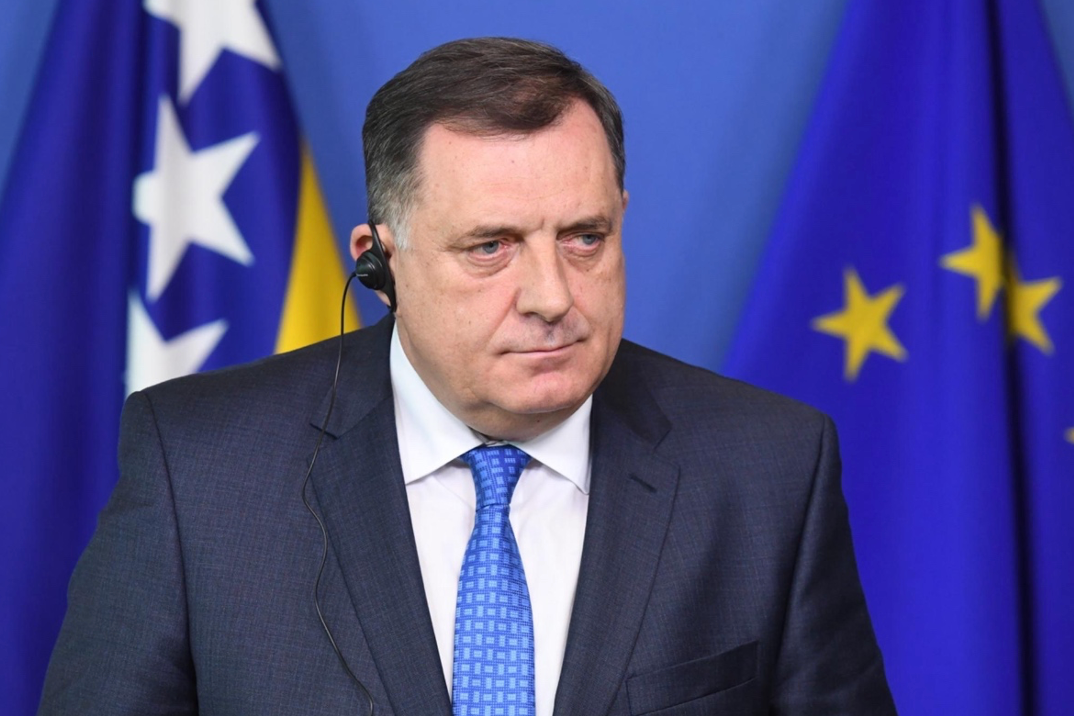
In April 2025, officers of Bosnia's state investigation agency arrived in East Sarajevo to arrest the most powerful man in half the country. Milorad Dodik, then president of the Serb-majority Republika Srpska, had ignored a court summons over his secessionist activity. What followed was an armed standoff, pitting state officers against the entity's own police until the federal agents simply withdrew. No shots were fired. Three months later, a court lifted the arrest warrant, and within two days, Dodik was back on stage declaring that Bosnia and Herzegovina was "not a state of Serbs but only a temporary refuge."
The episode barely registered internationally. It should have. A UN member state tried to arrest a sitting official for working to dismantle it and found it lacked the power to do so. That is Bosnia three decades after the Dayton Accords, a peace agreement ending the war in Bosnia reached by the leaders of Bosnia, Croatia and Serbia. The war might have that ended on the battlefield, but it continues inside the institutions built to contain it. Bosnia is not sliding back toward 1992; something quieter is underway, in the heart of Europe, with almost no one watching.
The Peace That Froze the War
Reached in November 1995 after nearly four years of war and an estimated 100,000 deaths, the Dayton Agreement was meant to stop the fighting, and it has held. Thirty years without organised ethnic violence, in a country that had just lived through the Srebrenica genocide in which more than 8,000 Bosnian males were killed, is no small achievement. But Dayton was never designed to build a state. Its two entities, Republika Srpska (RS) and the Bosniak-Croat Federation of Bosnia and Herzegovina (BiH), share deliberately weak central institutions, an ethnically rotating three-member presidency, and ethnic vetoes that routinely produce deadlock. Republika Srpska, born of ethnic cleansing, was recognized as a constitutional unit of the new state, a written admission that violence had paid off.
The Deadlock
The crisis of 2025 did not begin in 2025. For more than a decade, Dodik tested the state's authority through what Marko Prelec, a consulting senior analyst for the International Crisis Group, calls "carefully calibrated defiance" enacting separatist laws, then quietly shelving them. In February 2025, a state court sentenced Dodik to a year in prison and a six-year ban from office; RS's parliament answered the next day, rejecting the authority of state courts and police on its territory. By October, Dodik was out of office.
The victory dissolved almost immediately. That same month, the Trump administration lifted US sanctions on Dodik and dozens of associated individuals, the payoff of years of RS lobbying through Trump supporter-aligned firms in Washington. In November, Dodik's ally Siniša Karan won the RS presidency, vowing to continue his predecessor's course even more forcefully.
A court annulled the results from 136 polling stations, and a new presidential election was held in February with Karan still the winner.
Today, Dodik still controls the ruling Alliance of Independent Social Democrats (SNSD), and RS has since scrapped its referendum law's turnout threshold. "The sanctions were really hurting him, which is why he worked so hard to remove them," says Jasmin Mujanović, a political scientist specialising in the Western Balkans. The reversal, combined with the authorities' failure to pursue Dodik's arrest, "has been to the great detriment of the rule of law in BiH and the country's constitutional order," a missed opportunity he attributes to a failure of political leadership.
Yet outright secession would cost RS more than it gains: no state would recognise it, the Brčko district cuts its territory in two, and it already enjoys more autonomy than any subnational unit in Europe. Secession is not the goal; it is the business model, each threat harvesting concessions, patrons’ attention, and electoral advantage. But brinkmanship needs only one miscalculation, April's standoff ended because federal agents chose to withdraw. Nothing guarantees that choice next time.
The External Players
Russia's game in Bosnia is often misread. The Western Balkans are not a priority for Moscow, and that is precisely the point: maximum disruption at minimum cost. Russia's official economic footprint is negligible; what money flows, flows opaquely including, according to the Netherlands Clingendael Institute, direct financing of Dodik's past election campaigns. Nor did Moscow force its way in: Dodik has visited Russia more often than any European head of state. Moscow asks only that Bosnia stay blocked, out of the EU, out of NATO, out of function. One willing entity suffices.
Serbia plays a different game. Vučić's "Srpski svet" or Serbian World, envisions ethnic Serbs reunited in one national space, yet Belgrade cannot endorse secession without undermining its own position on Kosovo and its EU track. So, his support stays below that threshold, amplifying grievances against Sarajevo, keeping Dodik close and instrumental to his own hold on power.
Hungary's prime minister, Viktor Orbán, who lost in April elections after 16 years in power, has been more direct. Budapest repeatedly shields Dodik from EU sanctions through the bloc's unanimity rule and when the court convicted Dodik, 78 Hungarian anti-terror special forces soldiers were reportedly already in RS, having entered in civilian clothes with armored vehicles and a mobile operations center, officially for a "joint exercise" with Bosnian Serb special police. Russia can be countered because it stands outside the Western system; Hungary blocks from within the EU and NATO themselves.
And the West?
The EU opened accession talks in with BiH in 2024, but the reforms Brussels demands collide with the constitution Dayton built; 70 percent of Bosnians want membership. Yet Brussels is hardly a master of its own policy. Since Trump's return as US president, the EU has been "completely absent," in the words of European Stability Initiative analyst Adnan Ćerimagić, unwilling to confront Washington, whose interests now shape the ground more than Europe's own. European Union Force Bosnia and Herzegovina (EUFOR) numbers roughly a thousand peacekeepers, and US intelligence warned in 2024 that interethnic violence could overwhelm them. Nearly every element of that warning has materialised, while Western attention stays anchored to Ukraine.
Why It Matters
Bosnia's October elections will be the hardest stress test Dayton has faced in three decades and for the first time, without a permanent High Representative to referee them: Christian Schmidt resigned in May citing US pressure, and a US diplomat now minds the office while Washington and Europe deadlock over a successor. Mujanović's worst realistic scenario is the state presidency falling to anti-state elements, the SNSD taking the Serb seat, the Croatian Democratic Union (HDZ) the Croat one, producing "a presidential majority which trickles down into the government formation," and Dodik has vowed to prevent government formation after the vote. The realistic good scenario is the mirror image: opposition breakthroughs in the RS "could have a very positive moderating effect" not fixing Bosnia, Mujanović' cautions, but denying its most hardline elements "quite the same platforms that they've had to date."
Why should Europe care? Three reasons: precedent, security, and credibility. If constitutional separatism succeeds in Bosnia, the template is legible from northern Kosovo to Moldova. A security vacuum in the heart of the continent, with Western resources committed to Ukraine, is an invitation, and Moscow may already be testing it, amid reports of Russian-linked training camps in Bosnia tied to destabilisation plots in Moldova. And if Brussels cannot anchor a country it has formally promised a European future, enlargement means little from Kyiv to Skopje. A ceasefire that fails on the EU's doorstep does not stay a Bosnian problem.
The deeper problem, Mujanović argues, is that Bosnia lacks "the kinds of capacities that most states have" to rebuff foreign interference, a vulnerability "embedded into the Dayton Agreement as a means of ending the war," left unreformed for three decades: "a regime that was never intended to endure for as long as it has endured."
No actor, inside Bosnia or beyond, has incentives fully aligned with Bosnia as a single nation: Dodik needs the threat, Vučić the leverage, Moscow the paralysis, Brussels the delay. After years, Bosnians remain together because the rules require it, not because they have ever been given a reason to want it.
Whether luck can keep substituting for peace is the question October will answer.